
Private Label Fragrance: How to Build a Brand That Scales (and the Supply System Behind It)
Launching a private label fragrance is one of the fastest ways to build a brand with strong margins—when it’s done with the right supply and quality foundations. The mistake many new brands make is treating fragrance like a “creative project only.” In reality, private label is an operational system: scent selection, testing, packaging, repeatable production, and reliable restocking. Your customer may fall in love with the first bottle, but your business only wins if you can deliver the same experience again and again as demand grows.
AFAQ Fragrances supports private label and manufacturing buyers in Egypt through a B2B model built around imported sourcing, consistency, and scale. If you’re evaluating suppliers, start with AFAQ’s positioning as a Fragrance Oils Supplier in Egypt and explore how the company works with international partners via Partners and Fragrance Oils from Famous Perfume Houses.
1) Strategy First: What “Private Label Fragrance” Really Means in B2B
A private label fragrance is not simply “a perfume with your logo.” It’s a product line designed around a specific audience, price point, and distribution reality. Before you even choose a scent, you should define what you’re building: a premium fine-fragrance line for boutiques, a high-volume retail line, a niche concept brand, or an assortment for distributors. Each path changes everything—how strong the scent should be, what performance benchmarks you need, which packaging works, and how tight your supply planning must be.
The most successful private label operators treat fragrance as a repeatable commercial unit. That means your “hero fragrance” isn’t picked because it smells nice—it’s picked because it consistently wins in testing and sells in real environments. Buyers often underestimate how much the market rewards clarity. A simple positioning statement like “fresh office signature,” “warm gourmand night scent,” or “luxury woody profile” helps customers understand your brand instantly. From there, you can build a small assortment (3–6 SKUs) that covers distinct use cases. AFAQ’s curated content can help you understand how assortments are structured and refreshed through real market demand, such as 10 New Bestselling Fragrance Oils and 9 New Luxury Perfume Oils.
In B2B, your brand is only as strong as your supply chain. A private label fragrance that sells out but can’t restock reliably damages trust and blocks repeat purchasing. That’s why choosing a supplier is a strategic move—not a procurement detail. You want a partner that understands scaling from samples to bulk, managing recurring deliveries, and supporting you as you expand. If you want a clear framework for supplier evaluation, AFAQ’s resource on How to Choose a Fragrance Oil Supplier is a strong starting point for building your own procurement checklist.
2) Scent Development: Selection, Testing, and Batch Consistency (The Real Competitive Edge)
The most expensive private label mistake is launching a fragrance that performs well once—but inconsistently over time. For a brand, consistency is not optional: the second bottle must match the first. That’s why scent selection must be tied to performance testing and batch discipline. A fragrance oil can smell excellent on a blotter but behave differently in alcohol-based perfume, body sprays, creams, or even across seasons. Your success depends on selecting oils that hold up in your real base formula and deliver predictable longevity and diffusion.
A strong private label workflow begins with structured sampling: you test multiple directions, then narrow down to the top candidates and validate them under practical conditions. At minimum, you want to evaluate: (1) opening impression, (2) dry-down stability over hours, (3) longevity, (4) diffusion/sillage, and (5) how the scent behaves after a few weeks of storage. This is where professional sourcing matters. AFAQ supports this disciplined approach through technical guidance like Choosing the Right Fragrance Oil for Industrial Use, which helps buyers connect selection to production realities.
Quality control is where private label brands protect their reputation. Even a small drift in profile can create customer complaints—especially when your product becomes a repeat purchase. That’s why serious brands build QC into procurement and production, not as an afterthought. If you want to align your testing mindset with professional standards, review AFAQ’s resource on Quality Control & Testing. It explains why stability and verification reduce risk and improve long-term profitability.
Finally, consistency depends on supply planning. If your bestselling oil becomes unavailable, you face a painful choice: reformulate (and risk changing the scent) or pause sales. The more your brand grows, the more this risk matters. That’s why many private label operators choose suppliers with structured importing and partner networks that can support continuity. You can learn more about that supply context through Importing Fragrance Oils from Europe to Egypt, and explore category direction through Fine Fragrance Oil, Personal Fragrance Oils, and Home Fragrance Oils.
3) Packaging & Presentation: Bottles, Formats, and the “Shelf Decision”
In private label, packaging is not decoration—it’s a conversion tool and a cost center. Your bottle choice affects perceived value, shipping safety, production speed, and your ability to scale. A premium glass bottle can elevate your brand instantly, but only if it aligns with your price point and supply capability. For many brands, the right approach is to select a scalable bottle family that supports multiple SKUs without changing the packaging architecture every season. This makes restocking simpler, reduces cost volatility, and helps your brand look consistent in-store and online.
Start with your format: alcohol-based spray perfume, roll-on oils, body mist, or even home fragrance products. Each format changes the packaging requirements. Roll-on designs need functional, leak-resistant components and a comfortable application feel. Spray perfumes require reliable pump performance and compatibility with your formula. Home fragrance formats have different needs again. If you want a practical pathway to explore packaging options, AFAQ provides a dedicated section for packaging through Bottles. This is especially relevant if you’re building a full offering that includes fragrance materials and packaging planning in one procurement flow.
The strongest brands treat packaging as part of the sensory story: the bottle weight, cap design, label textures, and color system should match the scent direction. But none of that works if your packaging supply is unstable. Private label brands must be able to reorder the same bottle and components consistently. That’s why procurement should balance “beautiful” with “repeatable.” You can also explore AFAQ’s broader ecosystem via Shop and stay aligned with industry content and product releases through the Blog.
If you want a compact checklist for packaging decisions, here is a short framework. It’s best used after you’ve already defined your format and price point, because packaging should support strategy—not replace it.
- Format fit: spray vs. roll-on vs. other applications
- Leak resistance: transport, storage, and daily handling
- Brand consistency: a bottle family that works across SKUs
- Supply stability: reordering without delays or redesigns
- Unit economics: packaging cost aligned with your target margin
4) From Launch to Scale: Supply Planning, Restocks, and Building a Repeatable System with AFAQ
Most private label brands fail at the same stage: after the first success. A launch goes well, demand increases, and suddenly supply becomes the bottleneck—samples, packaging, oils, logistics, and production schedules start to slip. Scaling requires a supply plan that matches your growth pace. The ideal approach is staged: (1) sample and validate, (2) small production run, (3) build reorder signals based on sales velocity, and (4) move into a recurring restock cycle that protects your bestsellers.
AFAQ supports this approach by operating as a B2B partner for serious buyers in Egypt. If you’re building a manufacturing plan or a distribution assortment, you want a supplier that can speak the language of continuity and scale—availability, lead times, batch discipline, and technical guidance. AFAQ’s profile and approach can be explored through AFAQ Fragrance Company and the sourcing angle in Fragrance Oils from Famous Perfume Houses. For brands that position themselves with European sourcing narratives, the importing pathway via Importing from Europe to Egypt offers useful context for how structured supply is built.
Scaling also requires assortment intelligence. A private label brand should have: (1) core bestsellers that rarely change, (2) seasonal or limited launches that create excitement, and (3) targeted SKUs that capture specific customer segments. You don’t need 30 fragrances to look established—you need the right 6–12 with clear positioning. AFAQ’s editorial and product updates help wholesale buyers understand what’s moving and why, using content such as bestselling oils and luxury releases.
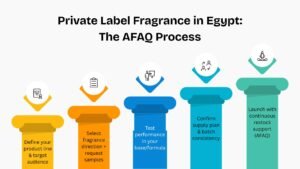
If you’re building a private label fragrance and want a supply partner that supports selection, testing thinking, and scalable restocking, contact AFAQ. Share your target category (fine fragrance, personal fragrance, or home fragrance), your expected volumes, and your preferred scent direction—then we’ll help you structure a private label plan designed for consistency and growth.